

The Workshop Legacy Stamp - Every Table Tells A Story
By Workshop Detroit
In a world of mass-produced furniture, there’s something extraordinary about a table that carries a story etched into its very grain. At Workshop Detroit, every table we design and build is more than a piece of furniture—it’s a piece of history, marked by our unique Workshop Legacy Stamp. This hand-applied stamp, bearing the street address of the reclaimed lumber’s origin, transforms each table into a tangible connection to Detroit’s past. Workshop Detroit is a beacon of sustainable craftsmanship, breathing new life into reclaimed wood by crafting tables from lumber salvaged from deconstructed houses and commercial buildings. The Workshop Legacy Stamp isn’t just a mark—it’s a symbol of sustainablity, community, and the beauty of reclaiming what was once forgotten.
In this blog post, we’ll explore the profound significance of the Workshop Legacy Stamp, from the meticulous process of reclaiming lumber to the artistry of crafting tables that tell stories. We’ll delve into how the stamp connects customers to Detroit’s history, supports sustainability, and redefines what luxury means in furniture. Whether you’re a design enthusiast or someone who values meaningful craftsmanship, the story of the Workshop Legacy Stamp will inspire you to see furniture—and reclaimed lumber—in a new light.

Close up of the Workshop Legacy Stamp on a recently completed Parsons Urban Farmhouse Dining Table. The stamp indicates the lumber was reclaimed form 3110 Cass Avenue in Detroit.
The Story Behind Workshop Detroit
Workshop started out as a simple idea: To build furniture in Detroit from lumber reclaimed from Detroit's vacant and abandoned building stock. We don’t just build furniture; we reclaim materials from the city’s deconstructed homes and commercial buildings, transforming structural lumber—2x4s, 2x6s, 2x8s, and sturdy wood beams—into tables that carry the weight of history. This lumber is what we use to fabricate most of our pieces from at Workshop. Essentially, we are giving lumber destined for a landfill, a third life.
Detroit’s buildings, many of which have stood for over a century, are more than structures; they’re repositories of stories. From grand Victorian homes in Brush Park to former factories, commercial buildings and houses in the storied neighborhoods on the east side, west side, north side and southwest, these buildings have witnessed the city’s evolution. Using reclaimed lumber isn’t just a sustainable choice—it’s a cultural one. Every knot, grain, and imperfection in the wood tells a story of the families, workers, and communities who once inhabited these spaces.
The Workshop Legacy Stamp is the heart of our brand identity. It’s a promise to our customers that each table is unique, crafted with care, and tied to a specific place in Detroit’s tapestry. By stamping the street address of the lumber’s origin onto every dining table, coffee table, console table and butcher block countertop, we invite owners to connect with the city in a deeply personal way. Whether it’s a table made from lumber sourced on Woodward Avenue or a quiet side street in Hamtramck, the stamp is a reminder that every piece of furniture carries a piece of Detroit’s soul.

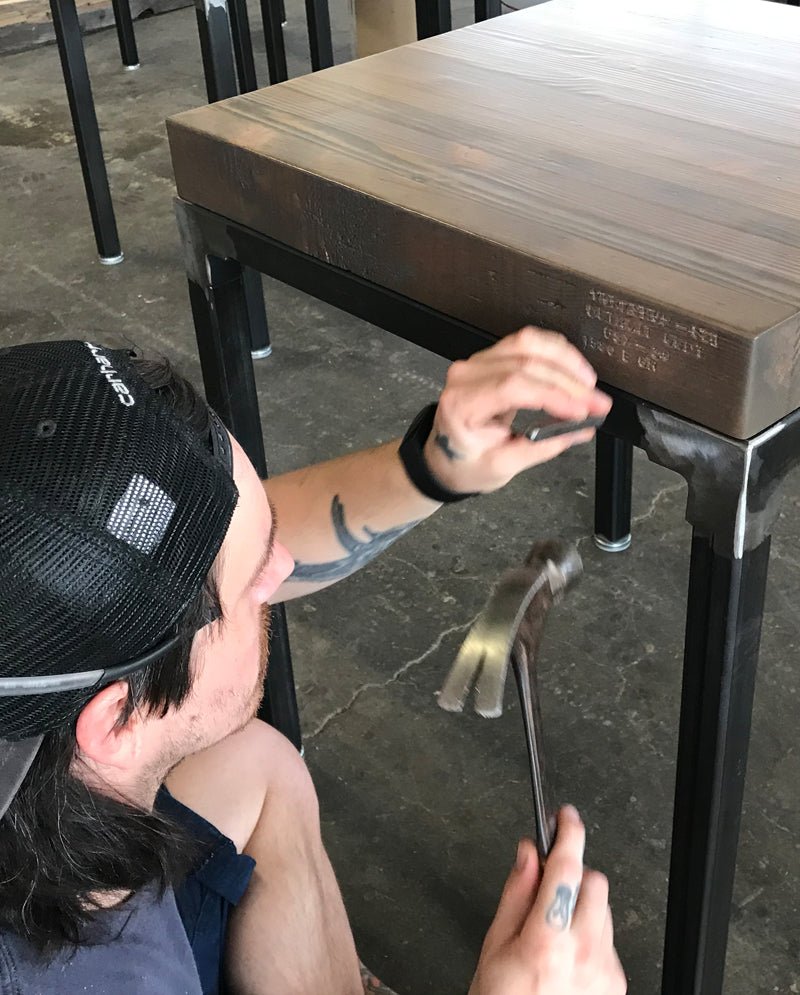
Action shot of a Workshop Detroit craftsman applying the Workshop Legacy Stamp to a completed table.
The Workshop Legacy Stamp: What It Is and Why It Matters
The Workshop Legacy Stamp is a simple yet powerful feature of every table we create. Hand-applied by our artisans, the stamp records the street address of the building from which the lumber was reclaimed. It’s not just a mark of authenticity—it’s a bridge between past and present, a way to honor the history embedded in the wood. Imagine running your hand over a dining table and knowing that its beams once supported a family home on Orleans Street or a factory on Michigan Avenue. That’s the magic of the Legacy Stamp.
The stamp itself is a work of art, carefully applied to complement the table’s aesthetic without overpowering it. Hand-applied with precision, it’s often placed in a subtle but visible location—along an edge or sometimes on the table's top or underside—ensuring it tells its story without detracting from the wood’s natural beauty. Each stamp is unique, reflecting the specific address tied to the lumber’s origin, making every table a one-of-a-kind piece.
For our customers, the stamp is more than a detail—it’s an emotional touchstone. A table stamped with “2462 Euclid ” might evoke memories of childhood for someone who grew up in that neighborhood. For others, it’s a conversation starter, sparking stories about Detroit’s history at dinner parties or family gatherings. The stamp transforms a functional object into a narrative, inviting owners to feel connected to a city that’s constantly reinventing itself.
Beyond its emotional impact, the Legacy Stamp is a testament to Workshop Detroit’s commitment to transparency. We track the origin of every piece of reclaimed lumber we use, ensuring that each table’s story is authentic. This dedication to traceability sets us apart in an industry often dominated by generic, mass-produced goods. The stamp is our way of saying: This table isn’t just furniture—it’s a piece of Detroit.

A stack of reclaimed structural lumber at Workshop Detroit salvaged from a 100+ year old house in Detroit.
The Reclamation Process: From Deconstruction to Table
The journey of a Workshop Detroit table begins long before it reaches a customer’s home—it starts in the heart of the city, where a team carefully deconstructs buildings slated for demolition. We work with local partners and sustainably source structural lumber rich in history, from century-old homes to industrial warehouses. Our goal is to reuse structural lumber—2x4s, 2x6s, 2x8s, and heavy wood beams—that can be transformed into furniture. This process isn’t just about reclaiming wood; it’s about preserving a piece of Detroit’s architectural DNA.
Deconstruction is a labor-intensive process that requires skill and patience. Unlike demolition, which reduces buildings to rubble, deconstruction involves carefully dismantling structures to preserve the integrity of the materials. Our local associates remove nails, sort lumber, and assesses each piece for quality. The wood we use—often pine, and sometimes maple and oak—bears the marks of time: weathered grain, nail holes, and subtle imperfections that add unique and beautiful character. These flaws are what make reclaimed lumber so special; they tell a story that new wood simply can’t.
After the lumber is salvaged and stored, it’s brought to our fabrication shop, where it undergoes a meticulous preparation process. The wood is cleaned, milled, and graded to ensure it meets our standards for strength and beauty. We take care to preserve the natural patina and unique features of each piece, whether it’s a knot from a century-old beam or the weathered texture of a 2x6 that once framed a family’s living room. Throughout this process, we meticulously track the lumber’s origin, recording the street address of the building it came from. This information becomes the basis for the Workshop Legacy Stamp, ensuring that each table carries its history forward.
Using reclaimed lumber has significant environmental benefits. By repurposing wood that might otherwise end up in a landfill, we reduce the demand for new timber, conserve natural resources, and lower our carbon footprint. But beyond sustainability, the reclamation process is about honoring Detroit’s past. Every piece of lumber we bring to life is a chance to keep the city’s stories alive, and the Legacy Stamp is the final step in that journey, marking each table as a piece of history reborn.

A detail shot of our Grand Urban Farmhouse Dining Table showing the Workshop Legacy Stamp. The stamp indicates the lumber used to make the table was reclaimed from 1907 Michigan Avenue in Detroit. The building was originally a factory for the Detroit-Alaska Hosiery Company.
Craftsmanship Behind the Tables
At Workshop Detroit, crafting a table is an act of artistry, blending traditional woodworking techniques with a deep respect for the material’s history. Our designs are minimalist yet bold, allowing the natural beauty of the reclaimed lumber to take center stage. Whether it’s a sleek dining table or a sturdy coffee table, each piece is built to highlight the wood’s unique grain, knots, and imperfections. These characteristics aren’t flaws—they’re the fingerprints of time, making every table a one-of-a-kind creation.
Our artisans approach each project with precision and care. The process begins with selecting the right pieces of lumber for each table, matching grain patterns and textures to create a cohesive design. We use time-honored joinery techniques to ensure durability and structural integrity. The result is furniture that’s not only beautiful but built to last for generations.
The application of the Workshop Legacy Stamp is a moment of pride in our workshop. Once a table is complete, our artisans carefully apply the stamp by hand, using a steel hand lettering tool that imprints the street address of the lumber’s origin. This process is done with intention, ensuring the stamp is clear and perfectly placed. For us, the stamp is more than a finishing touch—it’s a ritual that honors the journey of the wood, from a deconstructed building to a cherished piece of furniture.
Our tables come in a variety of styles, from rustic farmhouse designs to modern, clean-lined pieces. Some feature raw, unfinished edges that showcase the wood’s natural texture, while others are polished to a smooth, refined finish. The Legacy Stamp integrates seamlessly into each design, often tucked into a discreet corner or along the table’s underside, where it serves as a quiet reminder of the wood’s origins. For our artisans, every table is a labor of love, and the stamp is their signature—a mark of craftsmanship and connection to Detroit.

The lumber used to make this mid-century inspired Ellis Credenza was reclaimed from the historic Henry Glover house in Detroit's Brush Park neighborhood.
The Legacy Stamp’s Impact on Customers and Community
The Workshop Legacy Stamp resonates deeply with our customers, turning a simple table into a meaningful heirloom. For many, the stamp evokes a personal connection to Detroit. A customer might discover that their table’s lumber came from a neighborhood where they once lived, worked, or visited, sparking memories and a sense of pride. For example, imagine a family gathering around a table stamped with “1907 Michigan Avenue” only to realize it’s from the Corktown neighborhood where their grandparents raised their family. These moments transform our tables into more than furniture—they become storytellers.
The stamp also serves as a conversation starter. Guests at a dinner party might notice the stamp and ask about its meaning, leading to discussions about Detroit’s history, architecture, and resilience. For out-of-state customers, the stamp offers a tangible link to a city they may have never visited but feel connected to through their table. It’s a way to bring a piece of Detroit into homes across the country, spreading the city’s story far and wide.
Most of the addresses stamped on our Workshop furniture can be traced back to houses in Detroit neighborhoods that were built in the early part of the 1900's. However, sometimes the reclaimed wood that we obtain is from a more notable address. These locations have included reclaimed lumber salvaged from the former Packard Automotive Plant, the former Detroit Fire Department Headquarters (now the Foundation Hotel) in downtown Detroit and from the beloved transformation of the Henry Glover House in Detroit's Brush Park neighborhood.
On a broader level, the Workshop Legacy Stamp supports Detroit’s cultural and economic revitalization. By reclaiming lumber from deconstructed buildings, we contribute to the city’s efforts to clear blighted structures while preserving their legacy. Our work creates jobs for local artisans and strengthens the community by celebrating its history. The stamp is a symbol of this mission, reminding customers that their purchase supports sustainable practices and a city on the rise.

Ambassador Table by Workshop Detroit shown with a walnut stain finish. One of the many end results of using reclaimed wood at Workshop.
The Broader Significance of the Workshop Legacy Stamp
The Workshop Legacy Stamp is more than a branding tool—it’s a model for how craftsmanship can intersect with sustainability and storytelling. In an era of disposable furniture, our tables stand out as examples of thoughtful design, made from materials that carry meaning. We hope that the stamp inspires other artisans and businesses to consider the potential of reclaimed materials, whether it’s wood from old buildings or other salvaged resources. By showing that beauty and functionality can come from repurposed materials, we’re contributing to a broader movement toward upcycling and circular economies.
The stamp also redefines luxury in furniture. In a world where “luxury” often means shiny, mass-produced goods, Workshop Detroit offers an alternative: true authenticity, history, and craftsmanship. A table stamped with a Detroit street address isn’t just a status symbol—it’s a piece of art with a story to tell. This resonates with consumers who value meaning over materialism, who want their homes to reflect their values and their connection to the world.
As sustainability becomes a priority for more people, the Workshop Legacy Stamp serves as a reminder that the past can inform the future. By reclaiming lumber and honoring its origins, we’re showing that beauty, function, and environmental responsibility can coexist. Our hope is that the stamp inspires others to look at their surroundings with fresh eyes, seeing potential in what might otherwise be overlooked.
The Workshop Legacy Stamp is more than a mark on a table—it’s a celebration of Detroit’s history, a testament to sustainable craftsmanship, and a bridge between past and present. At Workshop Detroit, we believe that every piece of lumber has a story to tell, and the Legacy Stamp ensures that those stories are never forgotten. From the careful deconstruction of Detroit’s buildings to the artistry of our workshop, each table we create is a labor of love, stamped with the address of its origins and ready to become part of someone’s home.
We invite you to explore our collection at workshopdetroit.com and discover the beauty of reclaimed lumber for yourself. Whether you’re drawn to the rustic charm of a farmhouse table or the sleek lines of a modern design, each piece carries the Workshop Legacy Stamp—a reminder that even in a changing world, the stories of the past can find new life. Next time you sit at a table, consider the stories it might hold. With Workshop Detroit, those stories are stamped for all to see, connecting us to a city, a history, and a future built on resilience and creativity.
Ready to bring a piece of Detroit’s history into your home? Check out Workshop Detroit’s offerings, where you’ll find stunning dining tables, unique coffee tables, sleek console tables, sturdy benches and beautifully crafted butcher block countertops—each stamped with the Workshop Legacy Stamp. Make a purchase today and own a one-of-a-kind piece that combines sustainable craftsmanship with the soul of the city.